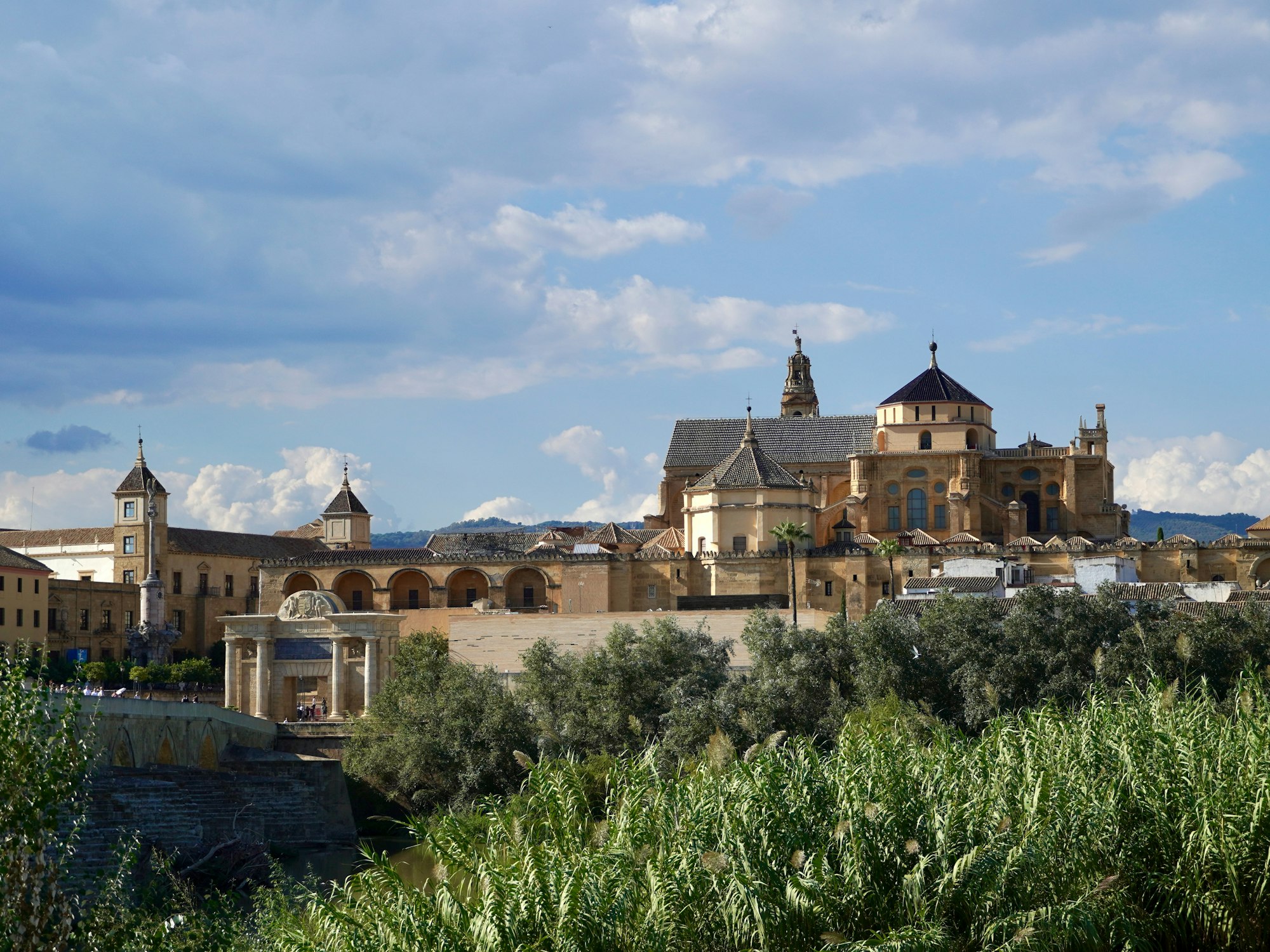
There was a time when Cordoba rivalled Baghdad and Constantinople as an intellectual centre of the known world. Capital of the Umayyad Caliphate in the 10th century, it housed one of the largest libraries of its era and a community of Jewish, Christian and Muslim scholars whose legacy still marks the city today.
The Mezquita, a cathedral inside a mosque
Nothing quite prepares you for walking through the forest of columns of the Mezquita-Catedral. More than 850 columns of marble, jasper and granite support superimposed two-tone arches, creating a uniquely infinite sense of perspective. At the heart of this 8th-century Muslim space stands, since the 16th century, an entire Renaissance cathedral, embedded within the original structure — an architectural layering that sums up the city's complex history in a single building.
The Judería, memory of the Jewish community
Around the Mezquita, the Judería district preserves one of the rare remnants of medieval Jewish presence in Spain: a small 14th-century synagogue, one of only three still standing in the entire country. Its narrow lanes lined with white façades and wrought-iron grilles are among the most photographed in Andalusia, particularly the famous Calleja de las Flores.
Cordoba's patios, a way of life listed by UNESCO
Cordoba has elevated the art of the flower-filled patio to the status of intangible cultural heritage of humanity. Throughout the year, some homeowners open their inner courtyards decorated with geraniums and fountains, a tradition that peaks every May during the patio festival, but which can be discovered more quietly across the San Basilio and San Lorenzo districts outside that period.
Medina Azahara, a forgotten palatine city
Around ten kilometres from the centre, the ruins of Medina Azahara reveal the splendour of the caliphate at its height: an entire palatine city, built in the 10th century, then abandoned and forgotten for centuries before being rediscovered. The UNESCO-listed site can be visited in complete calm, far from the density of the historic centre.
Where to stay in Cordoba
Accommodation in the Judería or around the Mezquita lets you explore the old town on foot, ideally early in the morning before the tour groups arrive. Several former palaces in the historic centre have been converted into charming hotels, offering interior patios and pools right in the heart of the old town.
When to go
March comes just before the Andalusian heat that makes Cordoba difficult to visit in summer: it's the ideal window to wander the city at a relaxed pace, ahead of the May patio festival crowds.

Passionate about travel and urban discoveries, I create guides to help travelers organize their getaways in the most beautiful cities in Europe and elsewhere. Through City Travelers, I share itineraries, practical tips and tour ideas to take full advantage of each destination, for a weekend or a longer stay.